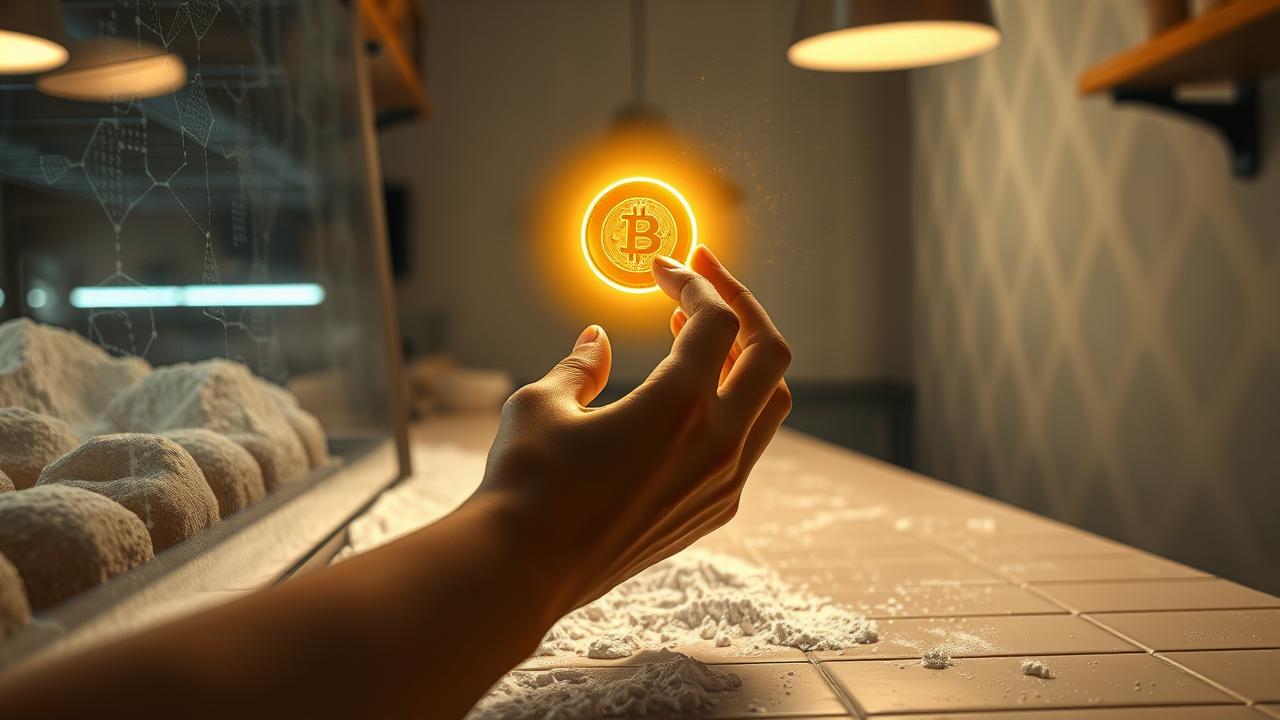
The fluorescent hum of the bakery’s display case was the only sound Brinley could hear over the ringing in her ears. Another notice from the bank, another “adjustment” to her merchant account fees, another piece of her soul chipped away by a system designed to siphon fractions of pennies until they amounted to a pound of flesh. She looked at the flour-dusted countertop, at her own worn hands, and felt a cold, quiet rage build in her chest. All this work, all this sweat, just to be told what her money was worth and how much of it she was allowed to keep. The world felt like a cage. And she was just beginning to realize the door wasn’t locked—it was just hidden in plain sight.
That whisper of defiance is where this journey begins. Not with charts or complex algorithms, but with a fundamental human need to own the value you create. Learning how to buy bitcoin isn’t about chasing a speculative craze; it’s about taking back a piece of control you may not have even known you’d lost. It is a declaration that your effort, your time, and your future belong to you.
The Unvarnished Truth in Under a Minute
You’re not here for a lecture. You’re here for a map. Here it is: You’ll pick a trusted platform, prove you’re you, connect a payment source, and buy your first fraction of a Bitcoin. It can be as little as twenty dollars. Then, for the love of all that is sane, you will learn to move it to a private wallet that only you control. That’s it. That’s the core of it. The rest is about mastering your own psychology so you don’t sabotage the entire operation.
Choosing Your Launchpad: Exchanges vs. Apps
The first decision feels like standing at a crossroads in a dense, digital forest. Do you go with a massive, sprawling marketplace or a simple, direct path? This choice boils down to centralized exchanges versus streamlined apps and brokers. There is no universally “correct” answer, only the one that’s right for your mission.
Exchanges like Coinbase or Kraken are the bustling Grand Central Stations of crypto. They offer a dizzying array of tools, charts, and different digital assets. For the person who wants to see the whole machine, to analyze its gears and levers, this is the place. You can set specific prices to buy or sell (limit orders) and get a feel for the market’s pulse. The trade-off? They can be overwhelming for a newcomer, and their fee structures can sometimes feel like solving a riddle wrapped in an enigma. Still, many of the top crypto exchanges are built to onboard millions, so their processes are well-trodden.
Then you have the apps—the express lanes. Platforms like Cash App, Strike, or BitPay prioritize speed and simplicity. Buying Bitcoin here is often as easy as ordering a pizza. Fewer charts, fewer options, less jargon. You connect your debit card or bank account, you tap “buy,” and you’re done. This directness is their greatest strength. The downside? You often pay a small premium for this convenience in the form of slightly less favorable rates or spreads. For your very first purchase, when the goal is simply to get on the board, this can be an incredibly powerful and unintimidating way to begin.
Executing the Mission: Your First Purchase
A thick fog of doubt had settled over Jamison’s small workshop, smelling of WD-40 and old regrets. Retired for five years, he’d watched the numbers in his savings account mock him, their value shrinking under the silent, relentless pressure of inflation. His pension was a joke, a fixed number in a world of ever-rising costs. The news talked about Bitcoin like it was a casino for tech billionaires. But his granddaughter, Kiana, talked about it like it was a lifeboat. With a grunt, he wiped his greasy hands on a rag, pulled out his phone, and decided it was time to either prove the kid wrong or find out if the boat could actually float.
This is where the rubber meets the road. It’s a precise, four-step operation. Execute it with clarity, and you’re in the game.
- Sign Up & Verify Identity: Pick your platform and create an account. You’ll need to complete a “Know Your Customer” (KYC) process. This is a standard anti-money laundering step, just like opening a bank account. You’ll upload a photo of your ID and maybe snap a selfie. It feels a bit intrusive, sure, but it’s a necessary credential for accessing this new financial system.
- Fund Your Account: Connect your funding source. This is usually a debit card, a direct bank transfer (ACH), or sometimes PayPal or Apple Pay. A debit card is often fastest; a bank transfer can have lower fees but might take a few days to clear. Jamison, ever cautious, linked his debit card but decided on a firm limit for his first sortie.
- Place Your Order: This is the moment of truth. You don’t need to buy a whole Bitcoin. You can buy $100, $50, or even $20 worth. You’ll see two main options: “Market Order” and “Limit Order.” A market order buys immediately at the current best price. A limit order lets you set a price you’re willing to pay, and the order only executes if the market hits that price. For your first time, a market order is the simplest way to get it done.
- Confirm the Transaction: The platform will show you a final confirmation screen: how much Bitcoin you’re buying and the total cost including fees. Take a breath. Look it over. Then, press the button. Jamison did, buying $50 worth. A tiny fraction of a whole coin. It felt both anticlimactic and monumental. He hadn’t gotten rich. But for the first time in years, he felt like he’d done something more than just watch his money die a slow death.
A Visual Briefing on the Buying Process
Sometimes, seeing the battlefield is better than just reading the map. The digital world moves with a speed that can be disorienting. This video guide offers a clear, step-by-step walkthrough of the buying process, helping you navigate the interface of a typical exchange with confidence. It’s a perfect primer before you make your first move.
The Vault: Never Leave Your Gold on the Counter
In the shared workspace he rented, surrounded by the quiet clicks of other people’s ambitions, Matteo stared at a blank screen. The email from the now-defunct exchange lay open in another tab, a digital tombstone. “Insolvency proceedings,” it said. It had all seemed so easy. The numbers went up, his small stake grew, and he felt like a genius. He left it all on the exchange, of course. It was convenient. It felt safe, like a bank. But it wasn’t a bank. It was a counterparty. A custodian. And when the music stopped, they took the chairs, the table, and his money right along with it. The sick, hollow feeling in his gut wasn’t about the lost profit; it was about the foolishness, the trust he’d placed in a smiling interface that was never truly his.
This is the most critical lesson in this entire space, a lesson often paid for in blood, sweat, and tears: Not your keys, not your coins. Buying Bitcoin on an exchange is just step one. Securing it is the war.
A “wallet” is simply a tool for storing and managing your Bitcoin. They come in two primary forms:
- Hot Wallets: These are software wallets connected to the internet. The wallet on the exchange itself is a hot wallet. So are mobile apps or desktop programs you download. They are convenient for spending or trading, but because they’re online, they carry a higher risk of being hacked.
- Cold Wallets (Hardware Wallets): These are physical devices, like a USB stick, that store your private keys offline. Brands like Ledger and Trezor are titans in this space. To send Bitcoin from a cold wallet, you must physically connect the device and approve the transaction. This creates a powerful air-gap between your wealth and the online predators trying toਾke it. Finding the best crypto wallets for your needs almost always leads back to one of these offline solutions for long-term storage.
The cardinal rule of self-sovereignty is to move your Bitcoin from the exchange to a personal wallet—ideally a hardware wallet—that you, and only you, control. It’s a non-negotiable part of crypto security best practices. To fail at this step is to leave your life’s savings on a park bench in a bad neighborhood and hope for the best. Don’t hope. Control.
Taming the Beast: Strategy in a World of Volatility
Once you own it, you’ll feel it. A flicker on a chart sends a jolt through your nervous system. A red candle on the screen can feel like a personal attack. This is the emotional battlefield, where more fortunes are lost than in any market crash. The inherent risks of cryptocurrency investing are not just technical; they’re psychological. Your own fear and greed are bigger enemies than any market fluctuation.
Winning here isn’t about perfectly timing the market—a fool’s errand. It’s about having a system that removes your flawed, emotional human brain from the equation. For those just starting out with crypto investing for beginners, the most powerful strategy is brutally simple: Dollar-Cost Averaging (DCA).
DCA means buying a fixed dollar amount of Bitcoin on a regular schedule—say, $50 every Friday—regardless of the price. When the price is high, your $50 buys less. When the price is low, it buys more. Over time, this smooths out the terrifying peaks and valleys, giving you a much healthier average entry price. It transforms volatility from a source of terror into an opportunity. It is the single most effective way to build a meaningful position without losing your mind.
This approach is the foundation of a real financial independence roadmap built on this new technology. It shifts the goal from “get rich quick” to “build wealth systematically.” It’s about playing the long game, developing the discipline to “HODL” (hold on for dear life) through the storms, and understanding that you are building something durable. This is the path to true digital wealth & crypto independence—not a lottery ticket, but a fortress built one brick at a time.
Your Armory: Trusted Exchanges and Wallets
Navigating the landscape requires reliable tools. While you must do your own research, certain names have established a track record for reliability and ease of use. This is not an endorsement, but a starting point for your own due diligence.
- Reputable Exchanges: For a blend of features and security, platforms like Kraken and Coinbase are industry mainstays. For simplicity and low fees, many users in the U.S. turn to an app called Strike.
- Hardware Wallets: When you are ready to secure your investment for the long term, Ledger and Trezor are the undisputed leaders. These devices are the gold standard for cold storage, effectively acting as a personal vault for your digital assets. Always buy directly from the manufacturer to ensure the device hasn’t been compromised.
Essential Field Manuals
Knowledge is armor. Before or after your first purchase, grounding yourself in the ‘why’ behind Bitcoin will fortify your resolve during periods of chaos. These reads can provide that crucial context.
The Age of Cryptocurrency by Paul Vigna and Michael J. Casey: This book isn’t a how-to guide but a ‘why-to’ manifesto. It lays out the historical and economic context for why a technology like Bitcoin was not just possible, but inevitable. It connects the dots between global finance and the promise of a decentralized alternative.
Bitcoin for Beginners by J.T. Jackman: If you want a straightforward, tactical guide, this is a solid place to start. It cuts through the jargon to deliver actionable advice on the mechanics of buying, selling, and investing without getting lost in the weeds.
Dispatches from the Front Lines: Your Questions Answered
How do beginners buy bitcoins?
The simplest path is to download a reputable, user-friendly app like Cash App or Strike, connect your debit card, and make a small initial purchase. This minimizes complexity and gets you started immediately. From there, you can graduate to a full-featured exchange like Coinbase or Kraken as your confidence and knowledge grow. The key is to start, even if it’s small.
Can you buy Bitcoin for $100?
Absolutely. You can buy Bitcoin for $100, $20, or even less. The idea that you must purchase one whole Bitcoin is a common and damaging misconception. You are buying a small fraction of a coin, known as a ‘satoshi.’ A $100 purchase simply buys you $100 worth of Bitcoin at its current market price. Starting small is the wisest way to learn the process without exposing yourself to significant risk.
How much Bitcoin does $1000 dollars buy right now?
The amount of Bitcoin you can get for any dollar amount changes constantly with the market price. For example, at a hypothetical price of around $65,000 per BTC, $1,000 would buy you approximately 0.0153 BTC. The important thing isn’t the exact fraction but the value you hold. The best platforms will show you precisely how much BTC you will receive before you confirm your purchase.
Down the Rabbit Hole
Your journey doesn’t end with a purchase. It begins. These resources can help you deepen your understanding of the vast world you’ve just entered.
- A Primer on Cryptocurrency: A solid overview for understanding the bigger picture beyond just Bitcoin.
- NerdWallet’s Investment Guide: A more traditional financial perspective on entering the Bitcoin market.
- r/BitcoinBeginners: A Reddit community for asking the questions you’re afraid are “too simple.” An invaluable resource for troubleshooting and community learning.
- Bitcoin.org: The original home for Bitcoin information, offering foundational knowledge and resources.
Your Turn on the Field
The feeling of powerlessness that Brinley felt in her empty bakery is a poison spreading through the world. But right now, you have the antidote in your hands. You have the map. You know how to buy bitcoin. The first step isn’t about becoming a millionaire overnight. It’s about making a choice. The choice to own something no bank or government can dilute or seize. The choice to step off the sidelines and participate in your own financial destiny.
Open the app. Link the card. Buy twenty dollars’ worth. Take the smallest possible action that proves to yourself that you can. Do it now.