The Bottom Line: You Are the Key
Forget everything you think you know about security being complicated. The core idea is this: your unique physical and behavioral traits—your fingerprint, your face, the very rhythm of your voice—are becoming the strongest shields you have. This isn’t science fiction. It’s the powerful, intuitive reality of modern finance, turning your own body into the one password no one can ever steal, copy, or forget. It’s biometric authentication in banking.
The Things They Measure
The night air on the construction site was still thick with the smell of diesel and damp earth. Perched on the tailgate of his pickup, Jimmy stared at the glowing rectangle in his hand, a bead of sweat tracing a path through the dust on his temple. He needed to pay the lumber supplier, now, or the framing crew would be standing around tomorrow, burning daylight and money. But the banking app was demanding a password he’d reset two weeks ago and promptly forgotten. Another failed attempt. He felt a surge of hot frustration, a feeling as familiar as the calluses on his hands. It was a tiny, infuriating barrier that made him feel powerless.
This is the exact battlefield where the first wave of biometrics won the war. It’s about replacing that maddening little password box with something immediate and physical. The most common methods you see today are:
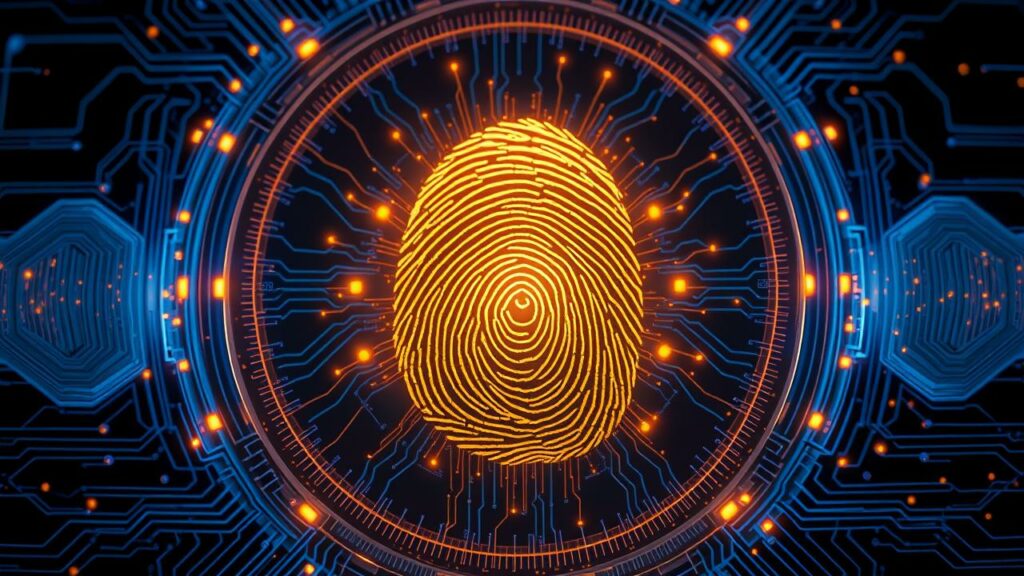
- Fingerprint Scanning: The ridges and valleys of your fingertip, a pattern unique in all the world. It’s the one that made biometric login mainstream on our phones. It’s fast, it’s efficient, and it’s what finally let Jimmy pay his supplier with a simple, decisive press of his thumb.
- Facial Recognition: The geometry of your face—the distance between your eyes, the curve of your jaw. It’s what lets you unlock your account with just a glance, even when you’re holding a coffee and a drill.
- Voice Recognition: The specific tone, pitch, and cadence of your voice. Banks use it to verify you over the phone, turning a simple phrase like “My voice is my password” into a cryptographic key.
- Iris Recognition: The intricate, colored pattern of your eye. Less common in mobile apps but used in high-security environments, it’s one of the most uniquely identifying markers you possess.
These aren’t just fancy replacements for a PIN. They often work as part of a Multi-Factor Authentication (MFA) system. Proving you are somewhere (with your phone) and proving you are you (with your fingerprint) is exponentially more secure than simply proving you know something (like a password your ex might have guessed).
The Ghost in the Machine
Sunlight streamed through the big office window, catching the dust motes dancing in the air. Taylor, a freelance UX designer, was deeply focused, her screen a collage of wireframes and color palettes. She was in the zone. Her banking portal was open in another tab, a forgotten soldier from a quick invoice check an hour ago. She felt a tap on her shoulder—a colleague asking for feedback. She got up, leaving her machine unlocked for what she thought would be a two-minute conversation.
That’s all it could have taken. A different coworker, burdened by debts and envy, saw the opportunity. A quick slide into her chair, a few clicks to the “Transfer Funds” page. He typed in a four-figure number. But as his fingers flew across the keyboard—faster, more erratic than Taylor’s deliberate keystrokes—and the mouse jerked across the screen in unfamiliar arcs, something silent and watchful took notice. The “Confirm” button grayed out. A notification pinged on Taylor’s phone. “Suspicious activity detected. Was this you?” He froze, then cursed under his breath and walked away as Taylor returned to her desk, oblivious to the digital bullet she had just dodged.
This is the unnerving, brilliant world of behavioral biometrics. It’s the security you don’t see. It’s an AI-driven guardian that learns you—not just your face, but your digital mannerisms:
- Keystroke Dynamics: How fast you type, the rhythm of your keystrokes, how long you hold down certain keys.
- Mouse and Swipe Patterns: How you move your cursor, the way you scroll or swipe on a touchscreen.
- Device Handling: The angle at which you typically hold your phone.
This creates a living, breathing “behavioral blueprint” that is constantly being monitored. If that pattern suddenly changes, the system flags it. It’s no longer about just getting past the front gate; it’s about proving you’re still you with every single click. This invisible layer of defense is a critical part of what makes up the future of money.
They Don’t Want Your Eyeball, They Want the Math
The quiet fear that bubbles up is perfectly understandable. “So the bank has my fingerprint? My face?” The imagination leaps to a dark vault somewhere, holding a perfect, high-resolution copy of your most personal data, just waiting for a heist. A completely reasonable, if slightly paranoid, concern.
The reality is far less cinematic and infinitely more secure. Banks and services like Apple’s Face ID don’t store a picture of your face or a scan of your fingerprint. They can’t. Instead, they perform a one-way conversion, turning your unique features into a complex mathematical representation—a biometric template. This is a string of numbers and code, not a photograph. It’s like turning a priceless painting into a unique, uncrackable equation. You can’t reverse the process to get the original painting back.
Even better, this data is often stored right on your device in a secure enclave, a digital lockbox on the chip itself that the banking app can ask for verification from but never directly access or copy. The app essentially asks your phone, “Is this the right person?” and your phone replies with a simple, encrypted “yes” or “no.” The bank never even sees the template. It’s a system built on trustless verification and privacy-by-design, a core tenet demanded by regulations like GDPR. So no, there is no shadowy figure analyzing your iris. There is only math.
A Glimpse Over the Horizon
The concepts of on-device security, advanced authentication, and moving beyond the password aren’t just happening in a vacuum. They’re part of a massive, industry-wide push to create a safer, more seamless internet. The experts at the FIDO Alliance are at the forefront of this movement, and their insights reveal just how deep this rabbit hole goes. Watching this gives a powerful glimpse into the standards that are making our digital lives fundamentally more secure.
When the System Says No
The soft glow of the table lamp cast long shadows across the living room. Dorothy, her joints aching from an afternoon of weeding her beloved garden, was trying to check her pension deposit. The bank had rolled out a mandatory app update. Her password no longer worked. “For your security, please enroll in facial or fingerprint ID,” the screen chirped, friendly and utterly unhelpful. Her hands, skin thinned by age and hard work, wouldn’t register on the phone’s sensor. Attempt after attempt failed. She tried the facial scan, but the phone, cradled in her lap, complained about the low light and the angle. A wave of cold fear washed over her. It felt like being locked out of her own house. The technology meant to protect her had become a wall, leaving her feeling isolated and utterly defeated.
Dorothy’s struggle is not a personal failing; it’s a profound engineering challenge. What happens when a legitimate user can’t be recognized? This is the flip side of the coin to fighting “presentation attacks”—fraudsters using photos, detailed masks, or even deepfakes to fool a system. Banks are in a constant arms race, employing advanced Presentation Attack Detection (PAD) like:
- Liveness Detection: Asking you to blink, smile, or turn your head to prove you’re a live person, not a static image.
- 3D Imaging: Using infrared dots or multiple cameras to create a depth map of a face, something a flat photo can’t replicate.
- Specialized Sensors: Detecting heat, blood flow, or other signs of a living organism.
At the same time, they must address the “template aging” and accuracy drift that affected Dorothy. Our faces change, our fingerprints can wear down. A robust system must be able to adapt, to learn, and to provide reliable alternatives when one method fails. This constant refinement is what defines the real digital banking evolution—it’s not a single leap, but a messy, human-centric process of continuous improvement.
The Currency of Convenience
Ultimately, why do we embrace this? Because a fortress is useless if you can’t get in and out quickly. The most profound benefit of well-implemented biometrics isn’t just the iron-clad security; it’s the beautiful, liberating absence of friction. It’s the seconds shaved off every login, the mental energy saved from not having to recall another password.
For Jimmy on his tailgate, it was the difference between rage and relief. For a busy parent paying bills between school pickup and soccer practice, it’s a moment of calm instead of chaos. This seamlessness dramatically improves the overall customer experience in digital banking. Transactions become fluid. Digital wallets become an extension of your hand. That confidence and ease is what banks are truly chasing.
And for the banks? The benefits are just as tangible. It cuts down on costly account takeover fraud and streamlines the entire identity verification process for new customers. They save money, you save time, and everyone is more secure. It’s that rare moment where everyone actually wins.
Your Questions, Answered
What are the 5 main types of biometric authentication?
While there are many, the five most frequently discussed are fingerprint recognition, facial recognition, voice recognition, iris recognition, and behavioral biometrics (like your typing pattern). Some lists also include palm or vein patterns as another physical type.
Is biometric verification necessary for bank accounts?
While increasingly common and strongly encouraged, it isn’t universally mandatory for all interactions yet, but its role is rapidly expanding. For many mobile apps, it’s becoming the default login method for its superior security. The core value of biometric authentication in banking is its ability to tie identity to a physical person, which is becoming a cornerstone of modern Know Your Customer (KYC) regulations and fraud prevention.
Can a banking app steal my fingerprint?
No. This is a common and valid concern, but that’s not how the technology works. A properly designed app, built on modern iOS or Android frameworks, does not get access to your raw fingerprint image. It requests authentication from a secure part of your phone’s hardware, which stores your biometric data as an encrypted mathematical template. The hardware simply tells the app “yes” or “no.” The app never “sees” or stores your print.
How secure is voice recognition for banking authentication?
It’s surprisingly robust. Modern voice biometrics don’t just match words; they analyze hundreds of unique characteristics of your vocal tract to create a “voiceprint.” These systems are also being trained to detect recordings or synthetic, AI-generated voices. While it can be a strong factor, it’s often best used as part of a multi-factor system rather than the sole method of authentication.
Your Path to Mastery
This is just the beginning. To truly understand the forces shaping your digital identity, explore these resources:
- FIDO Alliance: The organization creating the standards for passwordless authentication across the web.
- HID Global: A deep dive into the specific biometric solutions being deployed in the finance industry.
- Wipro Insights: A corporate perspective on how biometrics are changing transaction times and user experience.
- r/privacy: A community discussing the real-world implications and concerns of identity technologies.
Lock It Down. It’s Your Move.
Your financial life deserves a fortress, not just a flimsy lock. The power to build it is already in your pocket. Right now, open your banking app. Go into the security settings. If you haven’t enabled Face ID, fingerprint login, or any other form of biometric authentication in banking your institution offers, do it. Turn on multi-factor authentication. It will take you less than 60 seconds. This isn’t just about technology; it’s about taking a powerful, decisive step to reclaim your peace of mind. Your future self will thank you for it.