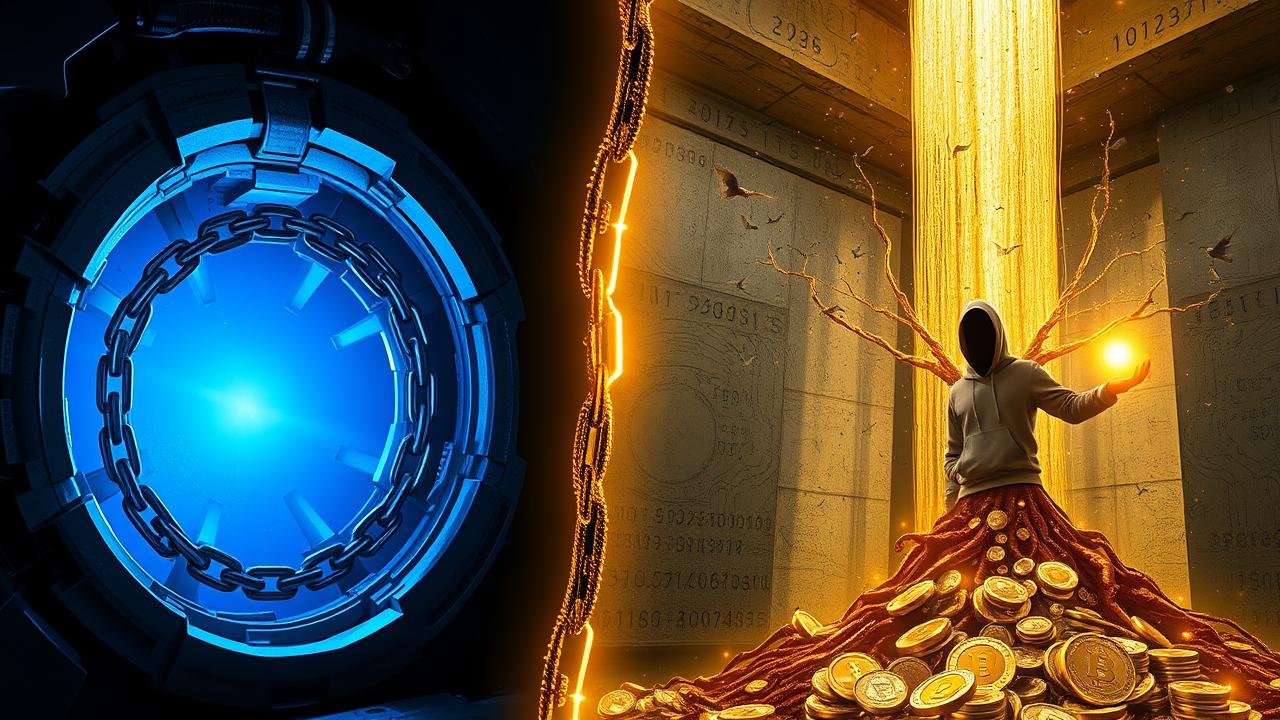
The blue light of the phone screen paints a face in the pre-dawn darkness. A single email sits there, a digital guillotine that has just fallen. Subject: “Account Action Required.” The words are sterile, corporate, but the meaning is a punch to the gut. The money is gone. Not stolen, but frozen. Inaccessible. A lifetime of work, a small business built on sweat and late nights, is now just a string of inaccessible numbers on a server somewhere in another state, or another country entirely.
This silent, bloodless annihilation is the dark inversion of our frictionless world. We celebrate the ease of tapping a card, of sending money across the globe in a blink. But beneath that convenience, a new architecture of control is being built. The fight for the freedom of transaction in the digital era is not some abstract debate for economists and tech evangelists. It’s a battle being waged in moments like this, in the quiet panic of a small business owner staring at a screen, realizing the floor has just vanished from beneath their feet.
The Battlefield at a Glance
The truth arrives like a cold slap. The convenience you’ve been sold is a gilded cage. Your ability to earn, spend, and save is increasingly held in the hands of a few monolithic payment processors and banks who can, and do, act as judge, jury, and executioner. This isn’t a conspiracy; it’s the emergent reality of centralized digital finance. But within this crisis lies the seed of a profound revolution. The same technology that enables this control also offers the tools for unparalleled autonomy. The power to break the chains is real, but it demands a different kind of courage—the courage to see the system for what it is and to take deliberate, powerful steps to reclaim your sovereignty.
The Velvet Glove of Cashless Convenience
A sterile, fluorescent-lit coffee shop on a Tuesday morning. The air smells of burnt beans and steamed milk. Every transaction is a silent, seamless ballet of technology—a phone waved over a reader, a card inserted, a number typed. Nobody carries cash. Why would they? It’s clumsy, dirty, slow. This is progress, a world where commerce is as easy as breathing. It’s a beautiful lie.
The woman fidgeting with her apron behind the counter doesn’t see it that way. In the back office, buried under a pile of invoices, is a letter from her payment processor. A new fee structure. A change in terms of service she doesn’t understand. She feels a low, simmering anxiety, a sense that she is no longer the owner of her own shop, but a tenant on someone else’s digital land. For all the talk about financial freedom and online platforms, the reality feels more like servitude. She’s heard stories from other vendors, hushed whispers about sudden payment platform account freezes for selling the “wrong” kind of art or for getting a few inexplicable chargebacks.
That is the deal we’ve all unknowingly accepted. We traded the tangible grit of paper money for the gleaming surface of an app, without reading the fine print that says the house always wins.
The Reality of Concentrated Control
Watching the slow disappearance of physical cash can feel abstract. This video cuts through the noise and exposes the fundamental choice we’re facing: is the death of cash about freedom, or is it about control? It lays bare the arguments and asks the questions the gatekeepers hope you never consider.
Source: Uptin on YouTube
Navigating the Minefield of the Canceled
In her small apartment, surrounded by the unsold, handcrafted jewelry that used to pay her rent, Leilani felt the walls closing in. The email from the payment platform was days old now, but the shock hadn’t faded. “Violation of Acceptable Use Policy.” No specifics. No person to call. Just a link to a 20-page document written in pure legalese. Her account, holding over three thousand dollars from recent sales, was locked for 180 days. Maybe forever. Her crime? She had no idea. Maybe it was the Celtic knot designs, flagged by an algorithm as a hate symbol. Maybe a competitor had spammed her with fraudulent orders. Maybe… anything. It didn’t matter.
This is the cold, hard reality of what is financial de-platforming. It’s not just a technical issue; it’s a form of social and economic exile. For Leilani, it was swift and brutal. Every attempt to open an account with a competitor was met with instant rejection. The system had marked her. The terrifying risk of payment processor blacklisting wasn’t a risk anymore; it was her life. Her experience joins a growing list of examples of financial censorship, where artists, journalists, and everyday business owners are cut off for holding the wrong opinions or simply tripping an automated wire.
The system is designed to protect itself, not you. And once you’re on the outside, a creeping dread sets in. It’s the understanding that the greatest modern nightmares don’t involve monsters in the dark, but the quiet, bureaucratic hum of a server deciding you no longer have the right to participate in the economy. The rise of centralized digital currency and constant monitoring only amplifies these existing financial censorship and de-platforming risks.
The Decentralized Counter-Strike
Across the city, a man named Santiago sat in his makeshift home office, the stale coffee in his mug mirroring his own exhaustion. He was a freelance structural engineer, managing projects in three different countries. He’d just read an article about a creator just like Leilani, and a familiar knot of dread tightened in his stomach. He lived his life through payment apps and wire transfers, completely at the mercy of intermediaries who could change the rules, or erase him, on a whim. The thought sent a jolt of raw adrenaline through him. Not here. Not to me.
That night, he didn’t sleep. He went down a rabbit hole, but this wasn’t the usual doomscrolling. It was a lifeline. He discovered the raw, untamed power of decentralization. He started to understand that Bitcoin and other cryptocurrencies weren’t just speculative assets; they were declarations of independence. They were systems built on mathematics and code, not on the whims of a compliance department. The concept of censorship-resistant payment networks lit up his mind. It was a path out.
For the first time, he saw a way to build a fortress around his livelihood. He started researching decentralized payment alternatives, not as a get-rich-quick scheme, but as a fundamental tool for survival. It felt like learning a new language, the language of self-sovereignty. It was confusing, intimidating, and utterly, profoundly empowering.
Fortifying Your Digital Self
Santiago’s journey wasn’t about becoming a crypto guru. It was about becoming untouchable. He started small, turning a portion of each client payment into Bitcoin and moving it immediately to a wallet he controlled. The first time he did it, his hand trembled as he confirmed the transaction. It felt like stepping off a cliff. But when the funds appeared in his self-custody wallet, the feeling was electric. It was his. Not his bank’s. Not the payment app’s. His.
This is the essence of digital self-defense. Santiago learned how to protect income from payment bans by simply sidestepping the gatekeepers. He invested in a hardware wallet—a small, unimpressive device that held the keys to his new financial world, completely offline. He began exploring multi-signature security for his business savings, a system requiring multiple approvals for any transaction, making it nearly impossible for a single point of failure (or coercion) to compromise his funds. These weren’t just abstract security measures; they were the bricks and mortar of his new fortress.
For those already cast out, the path back is harder, but not impossible. Strategies for rebuilding access after payment account bans often involve creating new legal entities or partnering with others, but the ultimate solution is always the same: diversification. Smart entrepreneurs are now implementing proactive online business de-platforming prevention by accepting both traditional payments and decentralized ones from day one, ensuring no single entity can ever pull the plug on their dream.
Designing a Life of Resilient Independence
In a dusty workshop on the edge of town, sparks flew from a welder’s torch. The air was thick with the smell of hot metal and ozone. Here, a man named Crue hammered and shaped steel into intricate, kinetic sculptures. His art was purely physical, a rebellion against the ephemeral nature of the digital world. Yet, his business was a masterclass in modern sovereignty. He took payments in Monero for his international commissioned pieces, valuing the privacy it afforded him and his clients. Locally, he traded his work directly for supplies, services, or even stacks of old-fashioned, wonderfully untraceable cash.
Crue’s approach wasn’t born of paranoia, but of a deep, philosophical commitment to autonomy. He saw his work, his income, and his life as an integrated system. He even owned a small ATM placed in a nearby convenience store, a passive income stream that was beautifully analog. He was, in his own gritty way, crafting a personal sovereign money blueprint. It was a plan that went beyond just earning money; it was about protecting his time, his focus, and his mental peace from the noise and control of the mainstream financial system.
This is the ultimate expression of transactional freedom: designing a lifestyle so resilient, so diversified between the digital and the physical, that no single corporate or government entity can hold you hostage. It’s about seeing your entire life as a canvas for defiant, sovereign creation.
Your Arsenal for Financial Liberation
Taking control isn’t about wishing for it; it’s about equipping yourself with the right tools. Forget the marketing hype. These are the instruments of power in the new economy.
- Non-Custodial Wallets: Think of an app like Muun or BlueWallet as your personal, sovereign bank vault on your phone. You hold the keys. You own the assets. The service can’t freeze your account because they never had control of it in the first place.
- Hardware Wallets (Cold Storage): A device from a company like Ledger or Trezor is your Fort Knox. It keeps the private keys to your digital assets completely offline, impervious to hackers and viruses. For any significant amount of savings, this is non-negotiable. It’s the digital equivalent of burying gold in the backyard.
- Privacy-Centric Protocols: When you need true confidentiality, systems like Monero provide a level of transactional privacy that Bitcoin does not. For businesses or individuals in sensitive positions, this is a critical tool. Second-layer systems like the Lightning Network can also offer a degree of privacy for smaller, everyday Bitcoin transactions.
Intellectual Ammunition: Your Reading List
The battle for your freedom is fought first in your mind. These texts are not just books; they are maps and manifestos for the journey ahead.
The War on Cash by David McRee: A stark, unflinching look at the forces driving society toward a cashless future and the hidden agenda of total control. It’s a wake-up call that shows you precisely what’s at stake.
Blockchain: Unveiling the Future of Secure Digital Ledgers and Privacy First Transactions by Fouad Sabry: Move past the headlines and understand the foundational technology. This is your technical manual for understanding how trust can be built with code instead of institutions.
Financial Freedom Roadmap: Building Wealth and Security by Elara Phoenix: A guide that connects the dots between the ‘why’ and the ‘how’. It reframes wealth building not as accumulation, but as the construction of a resilient, independent life.
Questions from the Trenches
But what if the government just bans Bitcoin?
It’s like asking if the government can ban the internet. They can certainly try to make accessing it difficult, criminalize on-ramps and off-ramps, but the network itself is globally distributed. No single entity controls it. Banning it in one country would be like trying to ban the ocean; the water just flows elsewhere. The real question is whether you are prepared to operate in a system that may not always have convenient bridges to the old world.
Isn’t crypto just for tax evasion and criminals?
That is the oldest, laziest smear in the book, typically wielded by those whose power is threatened by this technology. The vast majority of illicit transactions worldwide are still conducted using the US dollar. The most meaningful use of crypto is for people like Leilani and Santiago—honest individuals seeking to protect their property from arbitrary seizure. The fight for the freedom of transaction in the digital era is a human rights issue, not a criminal one.
This all sounds too complicated. Where do I even start?
You start by taking one single, defiant step. Don’t try to become an expert overnight. Your first step is to buy a small, insignificant amount of a decentralized currency like Bitcoin—an amount you’d be comfortable losing. Transfer it to a non-custodial wallet that you control. Watch it sit there. Feel the weight of what it means: for the first time, you are holding a digital bearer asset that no one can take from you without your consent. That feeling is where the revolution begins.
Continue Your Expedition
- Financial Freedom and Privacy in the Post-Cash World (Cato Institute)
- Economic Freedom in the Digital Age (CIRSD)
- Securing Financial Transactions in the Digital Age (Secarma)
- How cash is becoming a thing of the past (DW Documentary)
- r/Anticonsumption
- r/sovereignty
Own Your Economic Destiny
The system wants you to feel small. It wants you to believe you are powerless, a leaf tossed in the digital winds of commerce. It is the most profitable lie ever told. The power you need is already inside you—it is the unshakeable human spirit that demands to be free. The tools you need are already here, forged in code and decentralized consensus.
Your next step is not about investing. It’s about deciding. Decide that your financial life will be your own. Decide that you will not be a digital serf. The path to true freedom of transaction in the digital era begins with this choice. Take one small step today. Open a wallet. Learn about self-custody. Reclaim a tiny piece of your sovereignty. The fortress that will one day protect your family and your future is built one brick at a time, and the first brick is laid today.