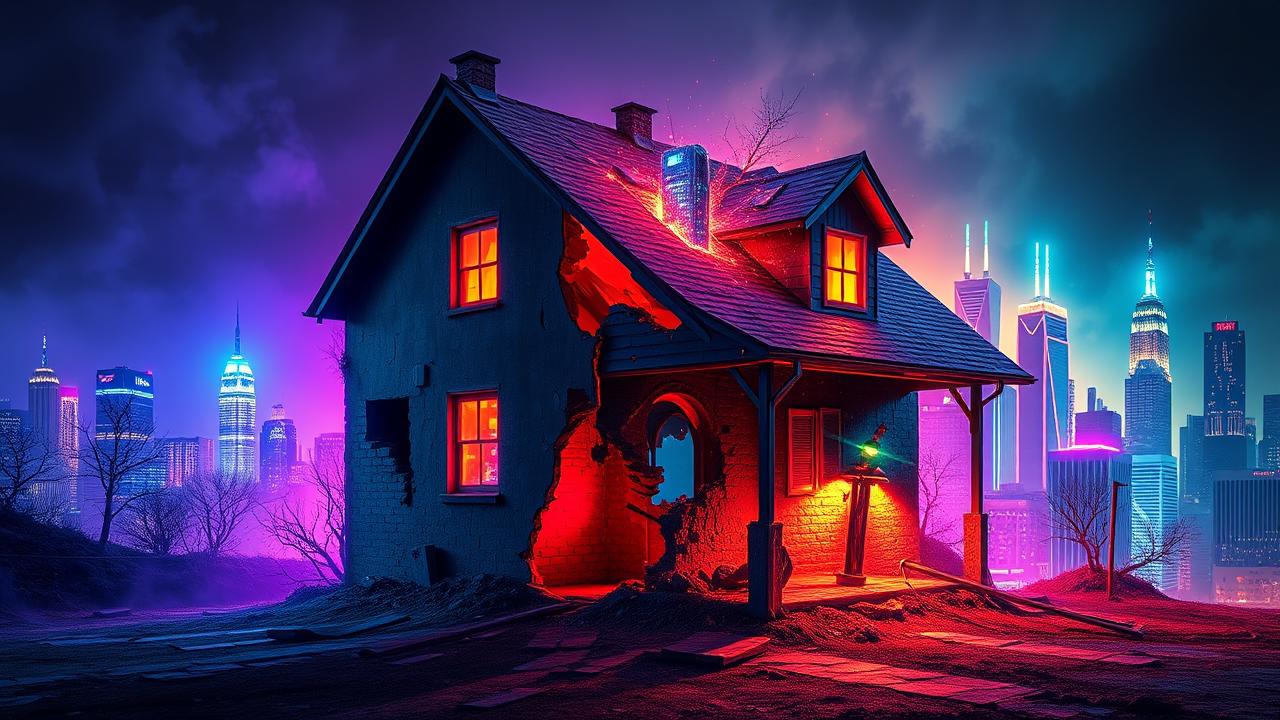
The Walls Are Closing In, Aren’t They?
You can almost feel it. The scent of fresh paint on a house you’ll never own. The echo of laughter in a backyard that isn’t yours. For generations, the dream of property ownership was the bedrock of stability, a tangible fortress against the chaos of the world. Now, for too many, it’s a ghost story told by their parents—a cruel joke where the punchline is a life of renting.
That front door, once a symbol of arrival, has become a wall. The system of high barriers, endless paperwork, and gatekeepers in expensive suits feels designed to keep you out. It whispers a devastating lie: you’re not meant for this. You don’t have enough. You are not enough.
But what if the key wasn’t a key at all? What if it was a line of code? This is where the world gets weird, where technology claws its way into tradition and offers a stick of dynamite to the whole crumbling structure. This is where we get the topic of real estate nfts explained, not as some abstract nerd fantasy, but as a potential crowbar to pry open that locked door.
The Core Truth in a Heartbeat
Forget the hype and the digital monkey pictures. A real estate NFT is a digital certificate—a unique, unforgeable token on a blockchain—that represents ownership of a real-world property. It’s the deed, reborn in the digital age. It can represent the whole property or, more powerfully, a tiny sliver of it.
This allows for selling off fractions of a building like shares, making investment accessible. It means transactions can happen in minutes, not months, cutting out many of the costly middlemen. It’s fast, it’s transparent, and yes, it’s risky as all hell. But it’s also a flicker of light in a very dark room.
A Ghost in the Machine That Owns a House
The night air in his cramped apartment was thick with the smell of microwaved noodles and quiet desperation. Staring at another rental increase notice, the paper felt heavier than it should, each word a link in a chain holding him down. He’d heard people talking about what is tokenized real estate, but it sounded like sci-fi nonsense, something for people with money to burn, not for guys trying to make ends meet.
His name was Trace, and he was an HVAC technician. He spent his days fixing the climate control in buildings he could never dream of affording. The irony wasn’t lost on him; it was a constant, bitter companion.
Then, a friend, half-joking, explained it. An NFT, or Non-Fungible Token, isn’t the property itself. Thinking of it that way is the first mistake. It’s the proof. The indisputable, cryptographically-secured record of ownership. It’s like having the deed to a house, but instead of a dusty piece of paper in a lawyer’s filing cabinet, it’s a unique digital asset stored on a global, transparent ledger called a blockchain. No one can forge it. No one can secretly alter it. It’s just… there. A ghost in the machine, screaming to the world, “This piece of earth belongs to this person.”
It’s not just a digital receipt; it’s a fundamental shift in how tokenized assets work. The legal agreements, the ownership rights, the title—all can be embedded within the token’s smart contract. It’s the deed and the lawyer and the escrow agent all rolled into one incorruptible digital package.
Pulling Back the Silicon Curtain
To truly grasp how this digital phantom can command a physical fortress, you have to look under the hood. It’s not magic; it’s code. The video below is a masterclass, breaking down the mechanics of smart contracts and the NFT standards that make this entire revolution possible. It’s not the sexiest part of the story, but it’s the most important. Watch it. Understand the engine before you try to drive the car.
Source: Chandler David Smith on YouTube
Two Worlds Collide: Pixels vs. Bricks
In a minimalist downtown studio, surrounded by sketches of sweeping, impossible architecture, a young architect scrolled through a glowing map of a world that didn’t technically exist. Light from the monitor traced the sharp lines of his face, a face filled with a hungry kind of curiosity. His name was Emmanuel, and he wasn’t just designing buildings for the physical world; he was designing them for the Metaverse.
It’s crucial to understand the schism here. When people talk about real estate NFTs, they are often talking about two wildly different things.
- Virtual Real Estate: This is what Emmanuel was exploring. It’s land and property within digital worlds like Decentraland or The Sandbox. You buy a plot of digital land as an NFT. You can build on it, rent it out, or host events. It’s speculative, weird, and feels a bit like buying a star a hundred years ago. Its value is tied directly to the popularity and utility of its digital universe.
- Physical Real Estate Tokens: This is the main event. It’s an NFT that represents a legal claim on a tangible, physical property. The duplex down the street. The office building downtown. The beach house you vacationed at last summer. The token is a digital twin of the real-world asset’s ownership deed.
Emmanuel saw the connection. He understood that the principles of scarcity, location, and utility that governed the physical world were being coded into the virtual. And the same technology—the NFT—was the bridge between them.
Unleash the Power: One Brick at a Time
Trace, our HVAC tech, fell down the rabbit hole. He spent his nights, after the hum of machinery had faded from his ears, reading. And he discovered the concept that made a fire light in his gut: fractional ownership. The idea was brutally simple. A single $2 million commercial building is impossible for him. But what about a 0.01% share of it for $200?
This is the earthquake. By tokenizing a property, the owner can mint, say, 10,000 NFTs, each representing a 0.01% stake. Suddenly, the towering walls of capital requirements crumble into a pile of dust. Anyone with an internet connection can buy a piece. You can own a sliver of a skyscraper in Tokyo, a fraction of a rental home in Miami, a piece of a warehouse in Ohio. It’s the ultimate democratization of an asset class that has been exclusive for centuries. You’re not just investing; you are claiming your piece of the world, one digital brick at a time.
The old fight of fractional ownership vs tokenized assets suddenly becomes clear. Traditional fractional ownership is slow, bogged down in paperwork and limited to accredited investors. Tokenization puts it on hyperdrive, opening it to everyone.
Why Bother? The Overthrow of the Old Guard
So, the old way is broken. We get it. But is this new way really better? On paper, the advantages are so profound they sound like a sales pitch from a con artist. And maybe they are. But maybe they’re also true.
- Blistering Speed: A traditional real estate closing can take 30 to 60 days. An NFT transaction can happen in minutes. The time saved isn’t just a convenience; it’s a massive reduction in risk and uncertainty.
- Gutting the Middlemen: Goodbye to many of the brokers, escrow agents, and title insurance companies, each one taking a slice of the pie. Smart contracts automate these functions, keeping more money in the pockets of the buyer and seller. It’s a brutal efficiency that has a lot of people in suits very, very nervous.
- Global Access: You can buy a tokenized property in another country as easily as you can order a pizza. Borders, exchange rates, and foreign banking laws become far less of a barrier.
- Radical Transparency: Every transaction is recorded on the public blockchain. Ownership history is clear, immutable, and verifiable by anyone. It’s a world with far fewer shadows for fraud to hide in. The grand vision for all tokenized real estate & assets is this relentless clarity.
These are some of the chief benefits of real estate tokenization, a litany of promises that sound almost too good to be true.
The Abyss Also Stares Back: The Risks
The house was quiet, paid for decades ago with a steady pension and smart, conservative choices. Dust motes danced in the afternoon sun, visible against the dark wood of a grandfather clock that had ticked through twenty years of peaceful retirement. But for Hayden, a retired logistics manager, the silence was a roaring accusation. Her life had been about managing risk, predicting failure points, ensuring the chain never broke. And she had failed.
She’d been intrigued, then excited. The promise of high-yield rental income from a fractionally-owned apartment complex, all managed through a sleek online platform, felt like the future. She did her research, or so she thought. She invested a significant piece of her nest egg. And then, the platform went dark. The developers vanished. The Discord channel fell silent. The NFT in her digital wallet, once representing a piece of a thriving property, was now just a useless string of code. A digital ghost of a ghost.
This is the other side of the coin. The visceral, gut-wrenching reality of the risks of tokenized real estate investing.
- Regulatory Chaos: The law is running to catch up. The legal framework for tokenized assets is a patchwork quilt of uncertainty. Is your token a security? A property? Something else? The answer could change overnight.
- Smart Contract Bugs: The code is law, until there’s a bug. An exploitable flaw in a smart contract can lead to a total loss of funds, with no recourse.
- Platform Risk: As Hayden learned, you are often trusting the platform or company that tokenized the asset. If they are fraudulent or incompetent, your “unforgeable” token may represent ownership in an asset they never legally controlled in the first place.
- Volatility and Scams: This is still the Wild West. The space is rife with hype, scams, and the kind of market volatility that can turn a fortune into dust before your morning coffee gets cold.
Your Arsenal for the New Frontier
Venturing into this space unarmed is suicide. You need tools. You need platforms that have been battle-tested and are building a reputation for legitimacy. These are not recommendations; they are starting points for your own obsessive, paranoid research.
Platforms like Propy are pioneers, facilitating the sale of entire physical properties as NFTs. They handle the intricate dance of binding the digital token to the legal, real-world deed. For fractional investing, a new breed of tokenized real estate investment platforms is emerging, allowing you to browse properties and purchase shares. Do not trust their marketing. Dig into their legal structure. Find out who the humans are behind the website. Read the whitepapers until your eyes bleed. This is not a place for blind faith.
Lingering Questions from the Edge of the Abyss
How do real estate NFTs actually work with deeds?
This is the linchpin. The NFT itself isn’t the legal title. Instead, the property is typically placed into a legal entity, like an LLC. Ownership of that LLC is then represented by the NFT or a series of fractional NFTs. The smart contract connected to the token governs the rights of the holder. So when you buy the NFT, you’re buying the rights to that LLC, which in turn owns the property. It’s a clever, if complex, legal wrapper that bridges the gap between atoms and bits.
Can I just convert my NFT back to real money?
In theory, yes. You can sell your property NFT on a marketplace for cryptocurrency, which can then be converted to dollars or your local currency. However, this depends entirely on liquidity. If no one wants to buy your tokenized fraction of a warehouse in Toledo, it’s worth exactly zero. You’re not guaranteed a buyer, just like you aren’t with a physical house. The difference is the potential speed and global pool of buyers… if they exist.
Isn’t this just a more complicated version of a REIT?
A fair question from a skeptic, which is the only sane way to be. A Real Estate Investment Trust (REIT) also allows you to invest in a portfolio of properties. But NFTs offer a key difference: direct ownership (via an LLC) of a specific property or fraction thereof. A REIT is a share in a company that owns properties. An NFT is a token representing your piece of the actual asset. This can lead to greater transparency and, potentially, more control and faster liquidity without relying on stock market hours. The distinction in the debate of real estate tokenization vs reits is about directness and transactional freedom.
Is this even legal?
It exists in a gray area that is rapidly getting color. The legality and regulatory treatment can vary wildly by jurisdiction. Some places are embracing it; others are hostile. This is perhaps the single greatest non-technical risk. Working with platforms that have robust legal teams and are transparent about their compliance is non-negotiable. This isn’t a space for rebels without a legal clause.
Further Down the Rabbit Hole
Understanding is power. Here are some tunnels to explore on your own. Approach with caution and a healthy dose of suspicion.
- NFTs: The Basics from Investopedia – A solid, no-nonsense primer.
- The Rise of Real Estate NFTs – A deeper look at the intersection of blockchain and property.
- Propy – See one of the major platforms in action.
- r/realestateinvesting – Hear from the trenches, but filter the signal from the noise.
- r/CryptoCurrency – For a broader perspective on the tech and market sentiment surrounding NFTs.
Armory for the Mind
Leaders are readers. The people who will win in this new world are the ones who consume knowledge like air. These aren’t just books; they are maps and survival guides.
The Psychology of Money by Morgan Housel: Before you even think about investing in a volatile asset, read this. It’s not about spreadsheets; it’s about the flawed, irrational, emotional wiring that makes us lose our shirts. Master your own mind before you try to master the market.
RWA – Real-World Assets on the Blockchain by Dwayne Anderson: This is your textbook. It dives into the mechanics of how tangible things, from apartment buildings to fine art, are being brought into the digital ecosystem. Essential reading to understand the foundation of this revolution.
Blockchain Technology by Deepak Gupta: If you want to go deeper than the surface, this book unpacks the core technology itself. Understanding the blockchain is like a mechanic understanding an engine. You don’t want to be a driver who knows nothing about what’s under the hood.
The First Step Is Not to Buy
There is no button you can press to get rich. There is no secret token that guarantees success. The dream they sell you of easy money is a siren song leading to the rocks where Hayden’s retirement savings were shattered. The path forward isn’t paved with blind optimism; it’s carved out with brutal self-education. Having had real estate nfts explained is not the end of your journey, but the terrifying, thrilling beginning.
Your first step is not to invest a single dollar. Your first step is to arm yourself with knowledge. Read. Watch. Learn. Understand the technology, the legal pitfalls, and the human psychology of greed and fear that fuels this market. This isn’t just about property; this is about the future of money itself, a wild and untamed force. The future of tokenized real estate investing will be forged by the informed, the prepared, and the resilient—not the hopeful and the naive.
The door is locked. But now you know a crowbar might exist. It’s up to you to learn how to wield it.