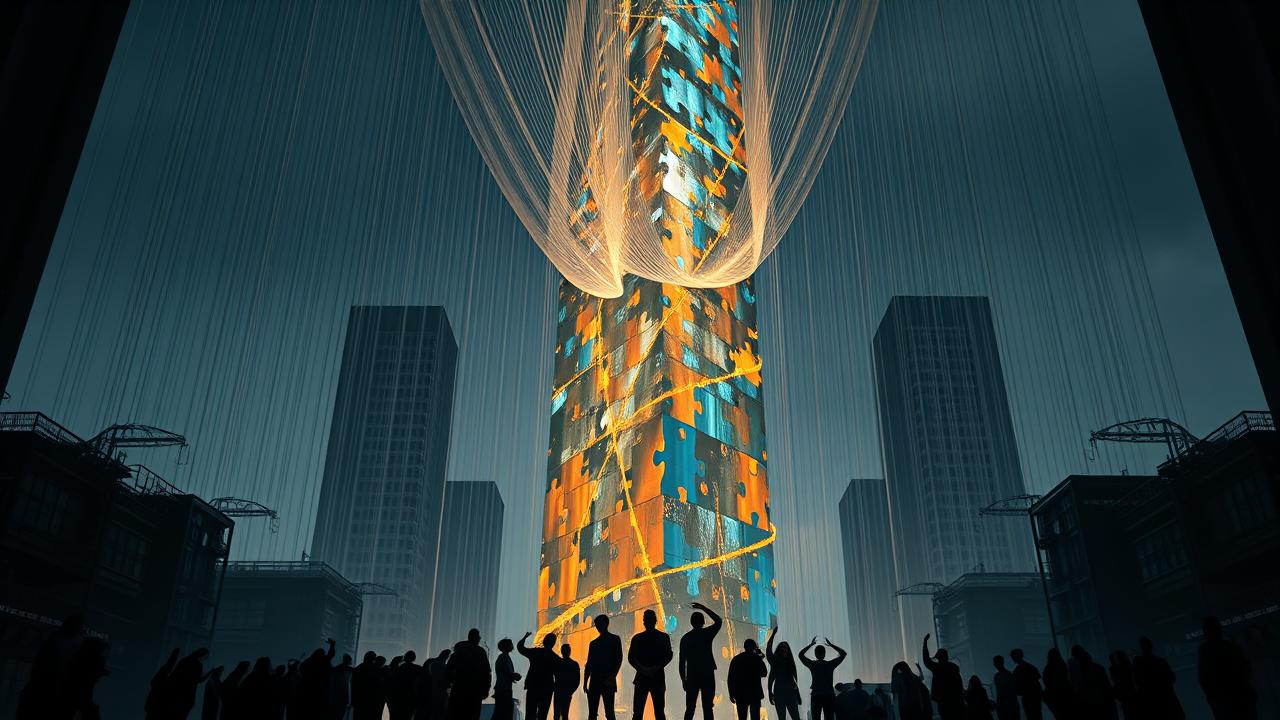
Why Your Transactions Must Be Unbannable
The email arrives at 3:17 AM. Not with a bang, but with a sterile, corporate chill that seeps into the bones. It’s a notification. A judgment. Your account—your lifeline, the digital vessel for your sweat and talent—has been terminated. Effective immediately. No appeal.
This isn’t a scene from some dystopian novel. It’s the lived nightmare for countless creators, activists, and entrepreneurs who wake up to find themselves financially excommunicated. Their crime? Being inconvenient. Holding the wrong opinion. Creating art deemed “unsuitable” by a committee in a glass tower thousands of miles away. They discover the terrifying truth that the platforms they built their lives on were never solid ground, but trapdoors waiting to spring.
This is where the fight for your own economic survival begins. It starts with a defiant realization: your ability to earn a living, to transact, to exist in the digital economy, cannot be a privilege granted by a faceless corporation. It must be an inalienable right, forged in code and secured by mathematics. It starts with understanding and embracing censorship-resistant payment networks.
The Unbreakable Code of Your Money
Here is the raw truth: trusting your entire livelihood to centralized payment processors is like building a mansion on a known fault line. This guide is your tremor detector and your architectural plan for an earthquake-proof foundation. We will not just theorize; we will walk through the digital rubble of lives upended by sudden account freezes. We’ll meet the people who were cast out and understand the visceral shock of being de-platformed.
Then, we will rise. We’ll dissect the very technology—decentralized ledgers—that makes true financial autonomy possible. You will discover the tools and, more importantly, the mindset required to operate outside the reach of those who would silence or starve you. This isn’t just about cryptocurrency; it’s about claiming a fundamental freedom of transaction in the digital era. It’s about ensuring that no one can ever pull the rug out from under you again.
The Day the Digital Guillotine Fell
In a small apartment that always smelled faintly of turpentine and digital ozone from her overworked tablet, Aleah created worlds. Her art, a vibrant and sometimes provocative exploration of fantasy and form, had found a dedicated audience. It wasn’t just a passion; it was her lifeblood, paying her rent, funding her dreams, one commission at a time. Her payment processor was the invisible, humming engine of her small enterprise. Until it wasn’t.
The email had no name, just a “no-reply” address. “Violation of Acceptable Use Policy.” Her balance—nearly three months of living expenses—was frozen, pending a “review” that felt more like a verdict. Panic, cold and sharp, pierced the morning calm. She scrolled through forums, her fingers trembling. Others were there, a digital refugee camp of artists, writers, and small business owners, all sharing the same sterile email. They were facing the full risk of payment processor blacklisting simply because an algorithm, or a person with a particular moral compass, decided their work was out of bounds.
This is the stark reality of centralized control. It introduces a single point of failure and judgment into your life. The question of what is financial de-platforming is answered not in a dictionary, but in the pit of your stomach when you realize a stranger has the power to turn off your income. The complete vulnerability to financial censorship and de-platforming risks became Aleah’s suffocating reality, a lesson she learned not in a classroom, but in the terrifying silence of a suddenly empty bank transfer screen.
Forged in Code, Owned by No One
How do you fight an enemy you can’t see? A decision made by a system you have no access to? You don’t fight it. You make it irrelevant.
This is the earth-shattering power of decentralized ledgers, the technology underpinning true censorship-resistant payment networks. Imagine a ledger, a record of every transaction. Instead of being held in one bank’s private vault, this ledger is copied thousands, even millions, of times across a global network of computers. No single person, corporation, or government owns it. They all just hold a piece of it, collectively verifying that it’s true.
When you send a payment on this network, you’re not asking a bank for permission. You are broadcasting a request to the entire network: “Move this value from me to Aleah.” The network’s participants, the nodes, cryptographically confirm you have the funds and that the request is valid. Once confirmed, the transaction is locked into the chain. Forever. It cannot be reversed, blocked, or frozen by some disgruntled employee or shifting corporate policy.
It achieves what was previously unthinkable: absolute resistance. Because there is no central authority to pressure, no kill switch to flip, and no one to “cancel” your account. The network is designed to be unhampered. The rules are math. And math doesn’t care about your politics, your art, or your opinions. It only cares if the transaction is valid. This is the foundation of financial freedom and online platforms built on resilience, not permission.
The Practical Path to Financial Immunity
Grasping the theory is one thing. Seeing it in action is another. The abstract concept of “decentralization” becomes a concrete weapon for your own sovereignty when you see precisely how these transactions are constructed to be private and unstoppable. The following video breaks down the mechanics, demonstrating how to create and use money that is fundamentally designed to protect you from interference and surveillance.
Source: Quai Network on YouTube
Ghosts in the Machine
Half a world away from Aleah’s quiet apartment, the stakes were different. Tomas, a freelance journalist, hunched over a laptop in a sweltering internet cafe, the air thick with the smell of stale coffee and anxiety. He wasn’t worried about acceptable use policies; he was worried about government thugs kicking down his door. His work involved exposing corruption, and the people he wrote about didn’t send sternly worded emails. They sent men with guns.
Getting paid was a dangerous dance. A direct wire transfer was a death sentence, a breadcrumb trail leading straight to him and, worse, to his sources. He depended on these nascent, privacy-focused networks to receive funds from international outlets. But technology is a tool, not a magic wand. In a moment of exhaustion, he made a mistake. He used a familiar public Wi-Fi network without his VPN, a tiny lapse in operational security that could unravel everything. For a week, he lived in a cold sweat, waiting for the knock on the door that thankfully never came. It was a brutal reminder that the tools of liberation demand a discipline of ghosts. You must learn to move without leaving a trace.
This is the harrowing side of the struggle. It isn’t just about how to protect income from payment bans; for some, it’s about protecting their very lives. Your defense isn’t just the network’s code, but your own unwavering practice of privacy. Using tools like Tor, encrypted communications, and private nodes isn’t paranoia. It is the tactical necessity for anyone who dares to speak truth to power in a world that is always listening.
The Architects of a Parallel World
On a cluttered desk littered with schematics and empty coffee mugs, Marshall typed code. He wasn’t a frontline activist or a struggling artist. He was a builder. A cynical, brilliant developer who had seen the pristine “Don’t Be Evil” mottos of Big Tech decay into engines of surveillance and control. He’d left that world behind, not for more money, but for a mission he could actually believe in: constructing a parallel digital infrastructure, one that was incorruptible by design.
He and a loose collective of developers from around the globe were working on a decentralized communication protocol. No central servers to shut down. No user data to mine and sell. Just pure, censorship-resistant information sharing. For Marshall, it was about more than just payments. It was about building the whole stack—chat, publishing, data storage—on a foundation that couldn’t be captured. It was a painstaking, often thankless job, building the lifeboats while everyone else was still partying on the Titanic.
This is the ultimate evolution of the idea: moving beyond resistance and into creation. It’s about architecting a complete sovereign money blueprint that extends to all forms of digital interaction. By building on public, permissionless blockchains, these pioneers are enabling a world where developers can create and innovate without asking for permission, and users can participate without fear. They are proving that cash flow data, when decentralized, can’t be gamed or suppressed by the powers that be.
The Open Gate and the Locked Door
The core difference boils down to a single, profound concept: permissionless versus permissioned.
A permissioned network is a private club with a bouncer at the door. Your bank, your credit card company, your favorite payment app—they are all permissioned. You must apply for an account. You must prove your identity to their satisfaction. They decide if you are allowed in, and they can kick you out at any time, for any reason. They hold all the power. The door is locked, and they hold the only key.
A permissionless network is a public square. Anyone can enter. Anyone can speak. Anyone can transact. There is no bouncer, no central gatekeeper. The network’s rules are encoded into the environment itself, transparent and applied equally to all. Bitcoin is the quintessential example. You don’t ask permission to create a wallet. You just create one. Your “identity” is a string of cryptographic characters. Your right to participate is guaranteed by the mathematics that govern the square.
For someone like Aleah, this difference is life-altering. The permissioned system saw her as a liability and locked her out. A permissionless system wouldn’t even have the capacity to make that judgment. The transaction is valid, or it’s not. That’s the beginning and the end of the story. This is the foundation for genuine online business de-platforming prevention, seizing the keys from the gatekeepers and melting them down.
Your Arsenal for Digital Sovereignty
Theory is a map, but tools get you to your destination. Arming yourself with the right technology is the first practical step toward building your own financial fortress. These aren’t just apps; they are instruments of freedom.
- Privacy-Focused Cryptocurrencies: While Bitcoin offers pseudonymity, currencies like Monero are built from the ground up for anonymity. They use advanced cryptography to obscure the sender, receiver, and amount of every transaction, making it practically untraceable. They are powerful decentralized payment alternatives for those who require maximum privacy.
- Self-Custodial Wallets: The mantra is “not your keys, not your coins.” Using a wallet where you control the private keys (like Electrum for Bitcoin or a hardware wallet like a Ledger or Trezor) means no third party can freeze or seize your assets. You are your own bank. This simple change is a revolution in itself.
- The Tor Browser: Tor encrypts your internet traffic and routes it through a volunteer network of relays, making it extremely difficult for anyone to track your location or online activity. It’s an essential tool for protecting your privacy when accessing exchanges, wallets, or any sensitive information.
- Decentralized Social Platforms: Protocols like Nostr are emerging as censorship-resistant alternatives to traditional social media. They consist of simple clients and relays, making it impossible for a single entity to ban users or delete content.
Blueprints for the Uprising
The fight for digital and financial sovereignty is being documented by those on the front lines. These texts provide the strategic, technical, and philosophical underpinnings for the world we are building.
- Blockchain: Blueprint for a New Economy by Melanie Swan: Forget the hype. This book lays out the foundational power of the blockchain not just as money, but as the next major computing paradigm—a global, incorruptible ledger for all forms of assets and data. It gives you the “why” behind the code.
- Masters of Invisibility by Lance Henderson: A raw, practical guide to operational security in the digital age. Henderson pulls no punches, treating privacy not as a hobby, but as a discipline of survival against corporate and government surveillance. This is the tactical manual for becoming a ghost in the machine.
- Building Blockchain Projects by Narayan Prusty: For the builders and the technically curious, this book moves from theory to practice. It provides tangible projects and frameworks for constructing the very decentralized applications that will form the backbone of the new, resilient economy.
Burning Questions on Financial Freedom
What is censorship resistance, really?
At its heart, censorship resistance means that no single entity—be it a company, a government, or a powerful individual—can stop you from participating in a network. In the context of censorship-resistant payment networks, it guarantees that as long as you follow the protocol’s rules (which are just code), your valid transactions cannot be blocked or reversed. It replaces the arbitrary judgment of a person with the predictable logic of mathematics, which is the only fair arbiter.
Isn’t Bitcoin still traceable and censorable by miners?
This is a sharp and important question. Yes, Bitcoin is not perfectly anonymous; it’s pseudonymous. The ledger is public, and with enough analysis, transactions can be linked to real-world identities. This is why privacy-centric coins exist. Regarding miner censorship, it’s theoretically possible for a large coalition of miners to agree to ignore certain transactions. However, this is incredibly difficult and expensive to coordinate, and it goes against their economic incentive, which is to process any transaction that pays a fee. While not immune, Bitcoin is vastly more resistant to censorship than any traditional financial system.
My account was frozen. What are the first steps for rebuilding?
The first feeling is panic. Acknowledge it, then put it aside. Your immediate goal is creating a new, independent channel for your income. This isn’t just about finding another processor that will eventually do the same thing; it is the moment to start rebuilding access after payment account bans by diversifying. Start small. Open a self-custodial wallet for a widely accepted cryptocurrency like Bitcoin. Begin educating your clients or customers on this new payment option, explaining it as a move toward stability and resilience. It’s a process of education for both you and your community, the first step away from dependency and toward true ownership.
Chart Your Course
The journey to sovereignty is ongoing. These resources provide deeper insights and connect you with the communities building the future.
- Liberty Street Economics: An analysis on the true resistance of decentralized systems.
- Bitcoin Magazine: Exploring the vital role of censorship-resistant communication with Nostr.
- XRPL.org: Technical documentation on how some networks build in automated censorship detection.
- r/darknetplan: A community exploring and building parallel, resilient systems.
- Nostr Explained (CoinGecko): A clear video breakdown of the decentralized social protocol.
The First Step Is Not a Step. It’s a Choice.
You have seen the fragility of the old system. You have felt the cold dread of powerlessness. Now you see the alternative. It’s not a magic button. It requires learning, discipline, and a shift in mindset from being a passive user to an active owner. The promise of censorship-resistant payment networks is not an empty one; it is a solemn vow written in cryptographic proof.
Your first step isn’t to become an expert overnight. It is to make a choice. Choose to own your value. Choose to control your financial destiny. Download a self-custodial wallet today. Read one article. Watch one tutorial. Take one tiny piece of your economic life and make it truly, unshakably yours. The power to do so is no longer in their hands. It’s in yours.