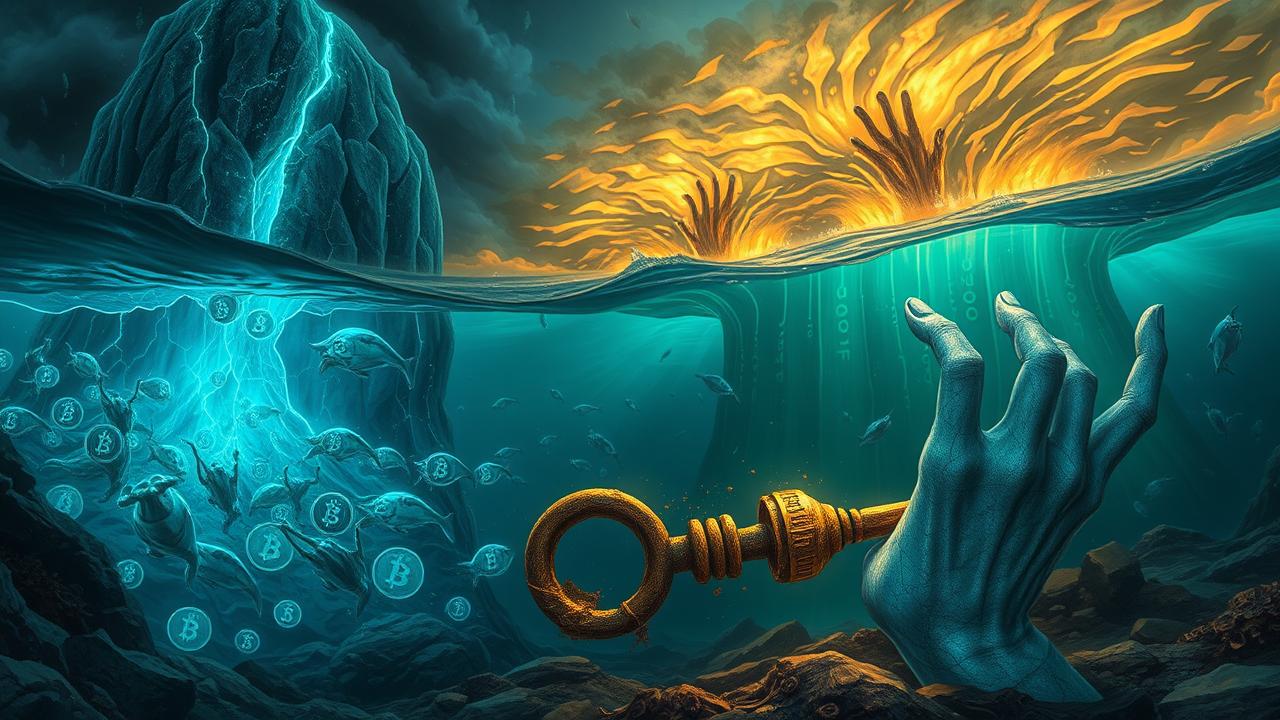
The promise glows with the intensity of a fever dream: Triple-digit returns. Banking without bankers. Absolute control over your own destiny. It’s a siren song sung in code, and it’s easy to get lost in the music. But beneath the shimmering surface of this new financial ocean, there are currents that can drag you down into the dark, cold depths before you even know you’re sinking. The real power isn’t in blindly chasing the light; it’s in understanding the shadows. The foundational what is decentralized finance defi conversation too often skips the part with the monsters, but acknowledging the very real risks of decentralized finance is the first, crucial step toward mastering them.
The Unvarnished Truth
This isn’t a bedtime story. This is the stark reality of a world built on code and conviction. Here’s what’s at stake:
- Code is Law, Until a Bug Becomes Judge and Jury: Smart contracts are immutable, but human programmers are not. A single flaw can become an unstoppable weapon for draining every last cent.
- The Market is a Raging Sea: Volatility isn’t a bug; it’s a feature. The same forces that create staggering gains can trigger catastrophic liquidations and wipe out liquidity pools in minutes.
- Anonymity is a Double-Edged Sword: The freedom from oversight that feels so liberating also creates a perfect hunting ground for anonymous scammers, hackers, and rug-pull artists. Recourse is a fantasy.
- Decentralization Can Be an Illusion: Many projects, cloaked in the language of DAOs, are still controlled by a handful of developers or large token holders, creating centralized points of failure you never saw coming.
The Ghost in the Machine
On the 37th floor of a glass-and-steel monolith, the city lights blurred into a river of gold and white far below. But inside the minimalist apartment, the only light came from the stark glow of three monitors, each reflecting the strained face of their owner. Siena, a lead systems architect for a fintech firm, saw the world in logical flows and elegant code. She prided herself on her meticulous due diligence, her ability to sniff out vulnerabilities lesser minds would miss. This DeFi protocol was no different. She’d spent a week combing through its open-source repository, mapping its dependencies, feeling the clean, cold logic of its structure. It was beautiful. Satisfied, she moved a substantial piece of her portfolio into it.
The feeling of power was intoxicating. This wasn’t some legacy bank giving her a pathetic 0.5% APY. This was her, using her intellect to unlock the future. The crash didn’t come like a thunderclap. It was a whisper. A number on her periphery that was just… wrong. Her stomach went cold. A cascade failure. Not in her chosen protocol, but in a smaller, interconnected one she’d dismissed as insignificant. A flaw there created a drain, and the complex architecture she had so admired became a series of collapsing dominoes. The numbers on her screen didn’t just drop; they evaporated. It wasn’t just the money. It was the violation. Her expertise, her logic, her fortress of code—all breached by a ghost, leaving her with a silence more terrifying than any alarm. This is the brutal reality of smart contracts in defi; they are run by software, and software is never perfect. The Achilles’ heel isn’t just a bug; it’s the hubris of believing you’ve found them all.
A Visual Guide to the Minefield
Sometimes, seeing the battlefield is the best way to understand it. The financial world is buzzing about DeFi, but the chasm between opportunity and danger is wide. This video breaks down the essential risks, from smart contract exploits to the unstable ground of market volatility, offering a clear-headed primer on what you’re truly up against.
Source: Learn About Economics on YouTube
Where Speed Kills and Hope Dies
His rig smelled of stale coffee and diesel, a familiar perfume that had defined his life for twenty years. From the driver’s seat of his Peterbilt, Omar saw the country unfold through his windshield, but his financial life unfolded on the small, glowing screen of his phone. He was a smart man, a survivor, but Wall Street had always felt like a private club he wasn’t invited to. DeFi was different. It felt raw, open, a place where a guy like him could finally get ahead. He’d found a liquidity pool, a pair of tokens he’d never heard of, promising an APY that made his heart pound. He’d put in a chunk of his savings, feeling a rebellious thrill. He was his own bank now.
He didn’t understand the term “impermanent loss” until it was too late. He just saw that as the value of one token skyrocketed, his total stake was somehow worth less than if he’d just held the coins in his wallet. It felt like a magic trick, a cruel sleight of hand. The panic was a physical thing, a tightening in his chest. This world of lightning-fast transactions, he realized, wasn’t just about opportunity. It was about speed. Capital could flee in an instant, like a bank run at the speed of light. Trying to understand the complex mechanics of how decentralized exchanges explained their operations felt like trying to read a foreign language in a hurricane. For every winner, he felt, there was a guy like him, sitting in a truck stop parking lot, watching his future bleed out on a five-inch screen.
The Faceless Thieves
The final blow for Omar came a month later. Chasing his losses—the oldest mistake in the book—he found a new project. It had a slick website, a charismatic anonymous developer on social media, and a community buzzing with manic energy. This time, he was sure. He put in what was left. For three days, his balance soared. The relief was so profound it was almost painful. Then he woke up one morning in a motel outside of Amarillo, opened the app, and saw a perfect, soul-crushing zero. A “rug pull.” The developers had vanished, taking the entire liquidity pool with them.
There was no one to call. No authority to appeal to. The anonymity that had seemed so empowering was now a suffocating shroud. He wasn’t just a victim of market volatility; he was a victim of a crime with no criminal, a theft with no evidence trail. This is the darkest corner of the ecosystem, the place where the lack of oversight makes the defi lending and borrowing explained promises turn to ash. This is why the U.S. Treasury frets about illicit finance threats, and why security audits and blockchain forensics are not optional luxuries but vital survival tools. The decentralized world is a frontier, and frontiers are full of bandits. The most significant how defi works for beginners lesson is often the harshest: you are entirely on your own.
The Illusion of Leaderless Power
There’s a beautiful lie at the heart of many DeFi projects: the idea of the Decentralized Autonomous Organization (DAO). A leaderless collective, governed by votes, where every token holder has a voice. It sounds like a digital Athens. The reality can be more like a digital boardroom where a few people own most of the chairs. This is the “decentralization illusion.”
Governance tokens, the very instruments of democracy, often wind up concentrated in the hands of the founding team or early venture capitalists. Their voting power can render the community’s voice meaningless. Worse, a malicious actor can acquire a majority of tokens or exploit the voting system through a Sybil attack, bending the protocol to their will. When the protocol’s treasury is drained or its rules are changed overnight, who do you hold accountable? The anonymous developers? The faceless DAO? This lack of developer accountability is a chasm of risk, a place where your investment can be compromised not by a hacker, but by the very “democratic” process meant to protect it.
The Shifting Sands of Law
Imagine building a house on land that could be declared a floodplain tomorrow. That’s the state of DeFi regulation. You are operating in a gray zone, a global financial experiment that governments are still struggling to understand, let alone regulate. One day a protocol is a revolutionary financial tool; the next, it could be deemed an unregistered security or a money-laundering risk by a body like the Financial Stability Board.
These regulatory landscapes are not a distant concern for institutions; they are a direct risk to you. A sudden crackdown, a new tax law, or a requirement for Know Your Customer (KYC) protocols could render your chosen platform illegal or inaccessible overnight. This uncertainty is a massive barrier to the kind of mainstream adoption that promises stability. You aren’t just betting on the code; you’re betting that the world’s governments won’t decide to shut the whole casino down.
The Siren’s Call of Complexity
In a quiet suburban home, amidst piles of gardening magazines, a retired small business owner was charting a new adventure. Jensen had spent forty years navigating payroll, inventory, and razor-thin margins. He wasn’t afraid of risk; he was afraid of irrelevance. He dipped a toe into DeFi, then a foot, lured by the dizzying yields. He learned about leverage, using his deposited assets as collateral to borrow more, then re-depositing that to earn yield on top of yield. It felt like financial alchemy.
The collapse of a complex algorithmic stablecoin he was using as a lynchpin in his strategy was swift and merciless. His leveraged position was liquidated in an instant. The loss stung, a familiar gut-punch from a business deal gone sour. For a day, he felt the cold tendrils of despair. But then, something else surfaced. Resilience. The same grit that saw him through two recessions. This wasn’t a defeat, he decided. This was tuition. He realized the highest yields came from the deepest complexity, and that complexity was a form of hidden risk. He had been chasing the number, not the knowledge. He abandoned the hunt for strategies like yield farming simplified into a single, enticing button, and committed himself to truly understanding the bedrock mechanics. The money was gone, but in its place was a hard-won clarity. He was no longer a gambler. He was a student. And now, he was ready to learn.
Your Shield and Compass
You are not helpless. Facing these risks doesn’t mean you must flee the arena. It means you must enter it armed. True power comes not from avoiding danger, but from understanding and mitigating it. These are your essential survival tools:
- Demand the Receipts (Security Audits): Before you put in a single dollar, find out if the protocol has been audited by a reputable firm like CertiK or Trail of Bits. Read the report. If there’s no audit, or the team dismisses its importance, run.
- Insure Your Fortress (DeFi Insurance): Protocols like Nexus Mutual offer a form of insurance against smart contract failure. It’s not a perfect shield—these protocols have their own risks and limitations—but it’s a layer of protection that can mean the difference between a total loss and a survivable one.
- Know Thyself (Portfolio Trackers): Don’t fly blind. Use a portfolio tracker to get a clear, unified view of your holdings and risk exposure across all platforms. You cannot manage what you do not measure.
Field Manuals for the Frontier
The journey to mastery is paved with knowledge. These texts offer deeper insights into the architecture of risk and reward in this new world.
- DeFi Risks and Rewards by Vivaan Acharya: A sober, clear-eyed examination of the entire ecosystem, breaking down the specific dangers and opportunities in a way that is accessible but never simplistic. It’s a foundational text for any serious participant.
- The DeFi Shield: Detecting and Preventing Rug Pulls in Decentralized Finance by S Williams: Consider this your guide to criminal psychology in the digital age. It provides actionable frameworks for spotting the red flags of malicious projects before you become another statistic.
Questions from the Abyss
What is the biggest problem in DeFi?
The twin demons are smart contract exploits and impermanent loss. One is a sudden assassination by a hidden flaw in the code, leading to an immediate and total loss. The other is a slow, confusing bleed, a risk specific to providing liquidity where market volatility can erode your position even when your chosen assets are performing well. Both stem from a lack of deep understanding, which is the true core problem.
Is decentralized finance safe?
No. But neither is driving a car or walking across the street. “Safe” is an illusion. DeFi is not safe in the way a federally insured bank account is safe. It carries a unique, potent, and often confusing set of dangers entirely distinct from traditional finance. The benefits of decentralized finance are balanced by a heavy burden of personal responsibility. Your safety isn’t guaranteed by an institution; it’s forged by your own vigilance, education, and risk management.
What are the crucial disadvantages of decentralized finance?
Beyond the primary dangers, the key disadvantages are brutal market volatility, the complete absence of a safety net or recourse when things go wrong, and a staggering level of complexity. The risks of decentralized finance are compounded by the fact that you serve as your own bank, security expert, and financial advisor. The freedom is absolute, but so is the accountability.
Explore the Landscape
True resilience is built on continuous learning. Use these resources to deepen your understanding of the forces shaping this space.
- U.S. Treasury’s Illicit Finance Risk Assessment: Understand how governments view the threats.
- Financial Stability Board Report: A global perspective on the systemic risks of DeFi.
- Georgia Tech Research: An academic look at rising security concerns.
- r/defi: A forum for real-time discussion, but separate the signal from the noise.
- BIS Paper on the “Decentralisation Illusion”: A critical analysis of governance risks.
From Surviving to Thriving
You’ve seen the abyss. You’ve heard the stories of ruin and felt the cold chill of reality. Do not let this paralyze you. Let it galvanize you. The fear you feel is a compass, pointing directly at the things you need to understand. The path forward is not to retreat but to advance with wisdom. Evaluate every protocol not with greed in your eyes, but with a healthy, productive paranoia. Start small. Learn the mechanics on a scale that won’t break you. The greatest risks of decentralized finance are not the code or the markets; they are ignorance and arrogance.
By facing the danger head-on, by choosing education over euphoria, you transform yourself from a potential victim into a risk-aware participant. This is how you take true control. And while the road is treacherous, this is how you can responsibly engage with what may be the future of money. To build that foundation, our guide on decentralized finance (defi) simplified is your essential first step.